




Instead of attending The Renewal Rally….OWN and rebrand it for a lifetime of success.

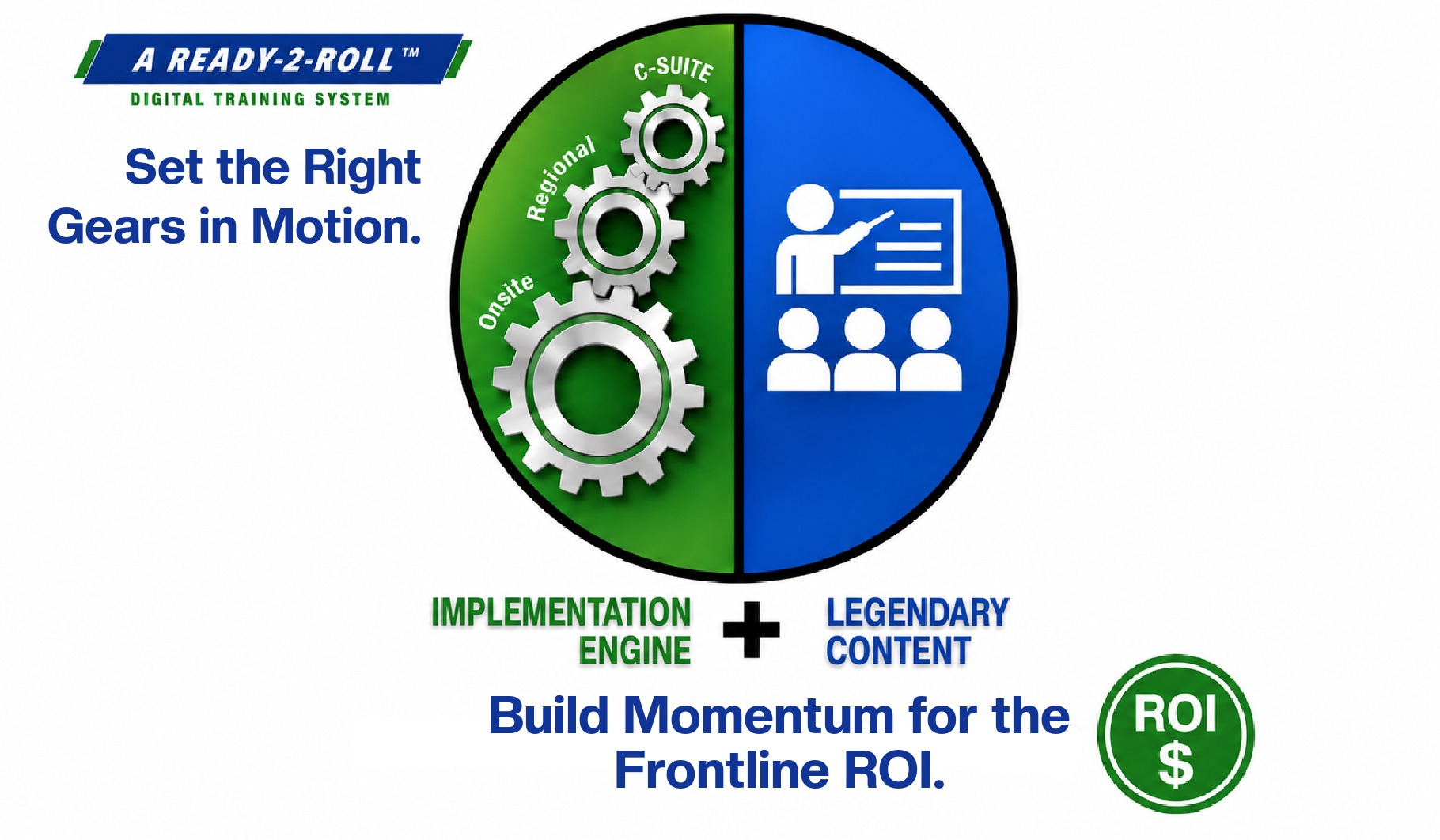
Ready-2-Roll Implementation Engine + Legendary Licensed Content
Set the Right Gears in Motion.
Build Momentum for Frontline ROI.
Great training ROI begins by setting the right organizational gears in motion—creating the leadership alignment, momentum, and support frontline teams need to succeed.
TWO PARTS = ROI
Part ONE: The Ready-2-Roll Implementation Engine
Toni Blake’s implementation guidance sets the right organizational gears in motion—beginning with C-suite alignment, moving through regional leadership, and building the momentum required to bring onsite teams fully on board.
Below, you will find the Renewal Rally implementation scope and deliverables, outlining the clear Phases required to move from purchase to practice, measure adoption and ROI, and celebrate the win.
Part TWO: Legendary Licensed Content
Renewal Rally gives your organization access to more than 40 years of Toni Blake’s field-tested training experience, transformed into practical, Ready-2-Roll resources that equip onsite teams to present value with confidence.
The Implementation Engine creates the momentum. Legendary Licensed Content gives teams what they need to succeed. Together, they drive ROI.
3-Step Executive Plan

Align the Leaders
- Meeting Notes
- Invitation List – Departments
- Executive Decisions
- Executive Permissions
- Executive Buy-in
- Executive Vision
- Executive Goals
- Departmental Decisions
- Departmental Permissions
- Departmental Buy-in
Assign Ownership
- Departmental Goals
- Departmental Task List
- Assign Leadership Ownership
- Define Accountability
- Set Expectations
- Establish Communication Rhythm
- Confirm Resources
- Remove Roadblocks

Customize the Brand
- Rebrand Language
- Align with Software
- Check Protocol Sequence
- Rebrand PowerPoint
- Rebrand Tools
- Rebrand Marketing
- Rebrand Participant Guide
- Confirm Brand Consistency
On-Site Team Accountability
Implement the Plan
- Plan LIVE or TEAMS Training
- Create Custom Branded Invite
- Set Exact Team Goal Expectations
- Define When/How for Measuring Progress
- Plan Contest and Rewards
- Share Participant Guide
- Create Team Access to Tools
- Controlled Burn – Light the Fire

Measure Results
- Track Leading Indicators
- Measure Against Goals
- Review Performance Data
- Adjust as Needed
- Share Results
- Recognize Progress
- Stay Focused
- Show Me the Money

Celebrate the WINS
- Celebrate Achievements
- Recognize the Team
- Capture Wins
- Share the Success
- Fuel Momentum
- Make it Fun
- Build Pride
- Create a Culture of Winning
A Ready-to-Roll Digital Training System
• Download • Rebrand • Reteach
…the best practices of the multifamily experience!

The Content: Introducing The Renewal Rally
10 Success Modules
1. Think Like an Owner
You are a Fiduciary
An advanced financial mindset is popular today. Approximately one in four Americans has a side hustle. This foundational module helps on-site teams shift from a basic employee perspective to an entrepreneurial, owner-minded one. Participants recognize their direct responsibility to strengthen the revenue flow and overall value of their community as a multimillion-dollar real estate asset. This is not simply rent collected—it is how we earn our market value.
The module emphasizes sound business decision-making grounded in facts rather than opinions, assumptions, or outdated information. Participants learn to identify trusted industry and economic sources, track meaningful market trends, and develop a consistent habit of reviewing current data. Using rent growth and inflation as examples, the module shows how comparing multiple data points clarifies market conditions and their impact on revenue decisions. It’s an entrepreneurial, Shark Tank-style business mentality—Mr. Wonderful would love it!
Participants are introduced to the four phases of the Multifamily Economic Cycle: Expansion, Hypersupply, Recession, and Recovery. They learn the key indicators for each phase and how to identify where their market may currently be in the cycle. Understanding the economic cycle helps teams make better-informed rent-growth decisions and align their marketing message with current market conditions.
Learning Objectives
By the end of this module, participants will be able to:
- Explain how renewal income affects the value and financial performance of a multifamily real estate asset.
- Identify trusted sources for multifamily market information, economic indicators, rent growth, inflation, occupancy, supply, and consumer trends.
- Use current market data to identify revenue growth opportunities.
- Establish professional habits for tracking, sharing, and reviewing market data.
- Name and describe the four phases of the Multifamily Economic Cycle: Expansion, Hypersupply, Recession, and Recovery.
- Recognize the key indicators associated with each phase of the economic cycle.
- Use the current market cycle to help guide rent-growth strategy and marketing messaging.
2. Never Concede Rent
A “Special” is Never Special for NOI
Time to put our entrepreneurial thinking into practice. Participants are challenged to examine one of the most common—and potentially costly—multifamily habits: offering free rent because competing communities do. Instead, participants are asked to center value before concession.
This module begins by defining concede: to surrender, yield, or give something up. Participants consider why they would concede the one revenue source they can most directly influence, given rent’s significant impact on the property’s income and market value.
The module shows how a seemingly small rent concession can create a much larger effect when multiplied across units, months, and capitalization value. It also challenges herd mentality. Just because other properties are giving rent away does not make a concession strategic, necessary, or inevitable.
The message is clear: Value first. Concession last. Before surrendering rent, teams must understand the market, evaluate the competition, strengthen residents’ perception of value, and confidently communicate why staying is worth it.
Learning Objectives
By the end of this module, participants will be able to:
- Define concede and connect its meaning to the financial impact of giving away rent.
- Explain how rent revenue influences a community’s income and estimated asset value.
- Recognize the cumulative effect of a seemingly small concession across multiple units and lease terms.
- Distinguish between a strategic pricing decision and a concession driven by competitive pressure or herd mentality.
- Evaluate local apartment specials and new-home incentives without automatically matching them.
- Assess how team confidence, resident value perception, reviews, and service performance affect renewal conversations.
- Lead with value before considering a rent concession.
- Approach rent decisions from an owner-minded, revenue-conscious perspective.
3. Raising Rents Without Raising Eyebrows
The New Inflation-free Lease
This module introduces Toni Blake’s original, field-tested renewal strategy, Raising Rents Without Raising Eyebrows, developed more than 18 years ago. At the center of the strategy is COBA (Cost of Business Adjustment): Toni’s proprietary approach to framing the annual rent increase as a fair, understandable business adjustment.
COBA is built around a concept residents already recognize: the annual Cost-of-Living Adjustment used by Social Security and tied to changes in inflation. Participants learn how to do the math, connect the renewal adjustment to credible economic data, and explain that the cost of operating and managing the residents’ community, their home, continues to change throughout the year.
Residents see prices adjust every day, every week, and throughout the year. COBA helps the team explain that the community is asking for one thoughtful annual adjustment to support the place where the resident lives. Renewal communication can include a link to current Federal Reserve inflation data, providing the conversation with an objective, verifiable foundation.
The module also helps teams reset negative perceptions of value, respond to resident objections, and turn common complaints into stronger value stories. Participants practice presenting COBA with confidence, clarity, and empathy because the goal is not simply to raise the rent. The goal is to help residents understand the reason behind the adjustment and the value of continuing to call the community home.
Learning Objectives
By the end of this module, participants will be able to:
- Define COBA: Cost of Business Adjustment and explain how it differs from an unexplained rent increase.
- Present Toni Blake’s original Raising Rents Without Raising Eyebrows strategy in clear, resident-friendly language.
- Use inflation and local operating-cost information to support a fact-based renewal conversation.
- Explain why one annual adjustment helps the community respond to costs that change throughout the year.
- Incorporate a trusted economic source, such as the Federal Reserve’s current inflation data, into renewal communications.
4. Maintenance First...then Celebrate with the Home-iversary
Serve First. Celebrate Second. Renew with Confidence
In our training sessions, maintenance professionals have confirmed that nearly every service visit uncovered additional unreported service needs inside the apartment. A dripping faucet, a slow leak, a stiff drawer roller, loose hardware, or another minor repair. Before presenting a resident with a rent increase, our service-first strategy includes scheduling a complimentary maintenance visit to identify and repair any needed services before the Home-iversary celebration. This service-first approach avoids objections that could derail the renewal conversation.
Let’s invite Paintscentsations to the Home-iversary Party! Disney’s success includes a patented Smellitzer that strategically delivers scent to create a full-sensory experience. Before leaving the apartment, the Renewal Rally full-sensory experience includes the service team completing paint touch-ups using Paintscentsations, welcoming residents home with an unexpected, fresh, clean fragrance to maximize the perceived value of our service team’s visit.
Timing matters. Apartments.com user data show that the average apartment search period fell from 46 days in 2021 to just 27 days in 2024. J Turner Research shows that 11% of renters begin looking for a new place within the first month. In this module, teams learn how to create a well-timed celebratory renewal experience built around an original TotallyToni holiday: the Home-iversary, before the property-management software generates the transactional 60-day automated legal notice. Training includes a personalized renewal strategy, customizable communication tools, complimentary sample graphics, service-team implementation guidance, sample telephone and email scripts, local business partnership ideas, and creative staging for successful in-person renewal signings.
Learning Objectives
Upon completion of this module, participants will be able to:
- Understand the importance of a well-timed Home-iversary before the automated 60-day legal notice period, replacing transactional automation with a personalized celebration.
- Coordinate leasing and service teams for a service-first renewal strategy to identify and complete repairs, as preparation for a COBA renewal offer.
- Include paint touch-up with Paintscentsations for an unexpected, multi-sensory service experience.
- Use customizable telephone scripts, emails, cards, and dessert selections to make the renewal ask more compelling and more direct.
- Develop partnerships with local bakeries or businesses to support the Home-iversary experience.
- Stage and deliver a successful in-person Home-iversary renewal signing that celebrates the resident’s decision to say YES to their address again.
5. Reframing the Negative On-line Narrative
The Five Pillars of PRO Renting
This important module helps teams understand the broad spectrum of messages shaping how renting is positioned in America through media coverage, online searches, and AI-generated results. By recognizing the negative narratives renters see, teams gain a clearer view through our Window of Opportunity and understand why they must be prepared to present the complete value of renting. The module introduces the Multifamily +Voice Alliance, the Five Pillars of PRO Renting, and the Online Comparison Audit for AI, which allows teams to examine what is being said about renting in their own market. It also introduces an important shift in perspective: rent covers the resident’s housing-related cost of living, including many property ownership expenses and responsibilities renters are not personally required to manage or pay separately.
Learning Objectives
Upon completing this module, participants will be able to:
- Identify the negative narratives influencing how renting, rent increases, fees, and property management are perceived.
- Explain how media coverage, online searches, and AI-generated results can shape renter expectations before the renewal conversation begins.
- Describe the Multifamily +Voice Alliance
- Describe the Five Pillars of PRO Renting.
- Conduct an Online Comparison Audit for AI to evaluate how renting is being positioned in their local market.
- Explain the ownership costs, services, and property-care responsibilities included in rent that residents are not personally responsible for managing or paying separately.
6. Presenting Apartment Value Against New-Home Sales
Moving is not Free
Today’s renters may be targeted by new-home offers promising little or no money down and by apartment communities advertising free rent. This module gives teams truthful, side-by-side information to help residents look beyond the advertised deal and understand the total financial impact of moving or buying—including moving expenses, mortgage interest, taxes, insurance, maintenance, repairs, and reduced flexibility. Teams learn how to explain that moving is not free and help residents determine whether staying in the apartment they already love is the better financial and lifestyle decision.
Learning Objectives
Upon completing this module, participants will be able to:
- Compare advertised homebuying incentives with the total cost and the long-term financial commitment associated with the offer.
- Identify ownership expenses and responsibilities that extend beyond the monthly mortgage payment.
- Evaluate whether a purchase concession offsets the actual cost of moving.
- Present truthful, resident-focused reasons to stay, including financial predictability, professional maintenance, flexibility, and freedom from major property-repair expenses.
- Practice discussing competitive offers without exaggeration, pressure, or criticizing the resident’s alternatives.
7. Presenting Value Against FREE Rent Specials
Say YES to the Address
Today’s renters are being targeted by nearby new communities promising FREE rent and a brand-new apartment right down the street. This module equips teams with truthful, side-by-side information that helps residents look beyond the advertised offer and consider the full financial, physical, and personal impact of moving.
Moving is widely recognized as a significant life stressor. It involves packing and unpacking, physical strain, lost time, disruption, and expenses ranging from hundreds to several thousand dollars, depending on the distance, the size of the move, and the services required. Research also supports that changing residences can increase a person’s overall stress level.
Using a $3,000 moving-cost example, teams learn how to make the financial comparison easy to understand. Spread over one year, $3,000 equals $250 per month. Unless the new apartment will genuinely save the resident at least $250 every month—after considering deposits, fees, utility changes, moving expenses, and other costs—the advertised FREE rent may not save them money at all. It could cost them money and require very real personal sacrifices.
Toni also shares 6 trends supporting why renters are staying longer in their apartment homes, the personal reasons residents really do want to stay, and 5 fun ways to refresh their current home when they say YES again to their current address.
Learning Objectives
- Compare an advertised FREE rent special with the complete personal and financial cost of moving.
- Apply the $3,000 moving-cost example to demonstrate the equivalent impact of $250 per month over one year.
- Help residents look beyond the advertised offer and evaluate deposits, fees, moving expenses, lost time, physical strain, and lifestyle disruption.
- Present truthful, side-by-side information without criticizing competitors or treating the established rent as negotiable.
- Identify 6 current trends supporting why renters are spending longer in their apartment homes.
- Recognize and reinforce the personal reasons residents genuinely want to stay.
- Share 5 fun ways residents can refresh their current apartment home when they say YES again to their address.
8. Flip the Script
The Role-Play Games
Experience is the greatest teacher. In this module, Toni Blake shares two powerful tools she learned while touring with a professional acting company: how to ad-lib and how to OWN a line!
Toni has built these skills into two interactive learning experiences: a Role-Play Card Game and OWN IT! Value Positioning Cards. The Role-Play Card Game uses real resident statements of objection collected in the field, paired with Positive Points of Consideration that help participants listen, respond, and Flip the Script.
Toni also shares 17 Value Positioning Concepts designed to help residents recognize the financial, emotional, and lifestyle value of staying. Through the OWN IT! cards, participants move beyond simply hearing or memorizing the concepts. They practice until the ideas become part of their own perspective, experience, and natural voice.
Learning Objectives
- Practice ad-libbing during real-time renewal conversations without relying on a memorized script.
- Build conversational skills through role-play using real resident statements of objection and relevant Positive Points of Consideration.
- Practice 17 Value Positioning Concepts that highlight the financial, emotional, and lifestyle value of staying.
- Listen, adapt, and select the Value Positioning Concepts that best fit each resident and conversation.
- Schedule live Role-Play Card Game practice sessions with an assigned Practice Partner to build confidence responding to unexpected questions, concerns, and objections.
- Use repeated practice to OWN the Value Positioning Concepts and present them from your own perspective, in your natural voice.
- Present value confidently and conversationally without bargaining over the rent or treating it as negotiable.
9. Area Village Marketing
More Reasons to Stay
According to J Turner Research, 11% of residents start thinking about and researching other apartments within their first month. In this module, Toni Blake focuses on building a trusted community and establishing Local Area Marketing Partners, or LAMPs, to help residents develop deeper roots in the surrounding area—their village.
When residents move, they do not simply have to find a new apartment. They will also have to find a new coffee barista who knows their order without asking, a hairstylist who listens, a favorite place to walk their fur baby, trusted service providers, favorite restaurants, trails, spas, coffee shops, breweries, and more.
Connecting residents to the village around them is a vital part of resident retention. These local relationships and favorite experiences give residents more reasons to stay and should become an ongoing focus of community social activities, resident conversations, and online social media content.
Toni highlights recent data from the Edelman Trust Barometer and explains why trust is an important part of a complete retention strategy. She also shares one of her newest creative resident activities: an adult coloring party that can be transformed into an Artful Resident FAVORITES office display featuring what residents love about their lives.
The finished artwork creates a meaningful community display while also becoming personal, resident-centered social media content that celebrates the people, places, and experiences residents value most.
Learning Objectives
- Understand why resident retention begins long before the renewal conversation.
- Identify opportunities to establish Local Area Marketing Partners throughout the surrounding village.
- Help residents recognize the local people, places, services, and experiences they would leave behind if they moved.
- Use resident conversations to uncover favorite restaurants, coffee shops, service providers, trails, spas, breweries, and neighborhood experiences.
- Apply trust-building concepts as part of a complete resident-retention strategy.
- Incorporate Area Village Marketing consistently in community activities, resident communications, and social media content.
- Create an Artful Resident FAVORITES activity and office display featuring what residents love about their lives.
- Use resident artwork and personal recommendations to create authentic social media content and more reasons to stay.
10. GEO Gold
Multifamily+Voice Influence in the Messy Middle
Renewal success will belong to companies that influence both on-site and AI-driven conversations. In this powerful module, Toni Blake provides an unprecedented collection of social media messages designed to celebrate the value of renting, the service delivered by the management team, and the significant costs paid by the property owner, which, as a renter, the resident is NOT!
In 2020, Google researchers introduced the “Messy Middle” decision-making model—the complex space between the moment a customer is triggered to begin exploring and the moment they finally make a purchase decision. For multifamily housing, the Messy Middle includes the ILS, the property website, ratings and review sites, social media, local online content, and now AI-generated search results.
Toni introduces creative graphics showing residents what ownership for landscaping, property taxes, property insurance, lawn care, seasonal flowers, maintenance, repair labor and supplies, appliance replacement, HOA expenses, and more. These real numbers help residents see everything being provided on their behalf.
This module is the icing on the cake of Renewal Rally. It helps residents recognize the value of their rent, the amazing work performed on their behalf, and the emotional comfort of knowing they are not financially responsible for the roof, the landscaping, the sprinkler system, the appliances, the property taxes, or the next unexpected repair. Someone else will mow the lawn, maintain the community, repair the appliances, and take responsibility for the property, freeing the resident to enjoy the pool and amenities!
Learning Objectives
- Explain Generative Engine Optimization and how AI-generated answers are influencing the renter’s search for a new address.
- Describe Google’s Messy Middle and identify the online channels residents use while exploring and evaluating their housing choices.
- Develop content that can positively influence both the onsite renewal conversation and the AI-driven conversation.
- Show residents the actual cost of property expenses, services, maintenance, and ownership responsibilities included in their rent.
- Apply Toni’s PROrenting social media concepts to celebrate the value of renting and the work performed by the management and service teams.